

Courses
23-05-2023
Vote
-
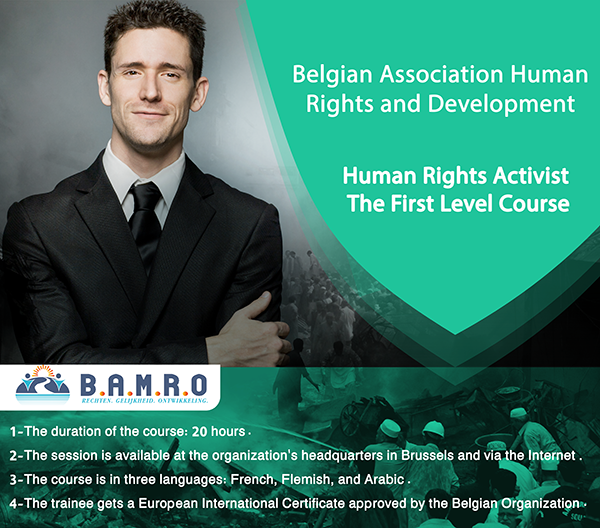
For further training via the Zoom program or at our office? ?
Register a
Violation
We you
Contact youS.O.S.
0032 02 7322568
The Right to Education During Armed Conflicts: A Legal and Humanitarian Responsibility That Cannot Be Delayed
The Right to Education During Armed Conflicts: A Legal and Humanitarian Responsibility That Cannot Be Delayed
Issued by the Belgian Association for Human Rights and Development (BAMRO)
Introduction
The right to education is one of the fundamental rights guaranteed by international human rights instruments, foremost among them the Universal Declaration of Human Rights and the International Covenant on Economic, Social and Cultural Rights. However, this right is currently facing unprecedented challenges due to the escalation of armed conflicts and humanitarian crises in many regions of the world. United Nations discussions in 2026 indicate that hundreds of millions of children are living in conflict-affected areas, threatening the future of entire generations and depriving them of their most basic rights.
Human Rights Reality
Wars no longer result only in the loss of security and stability; they have become a direct cause of educational disruption through the destruction of schools, population displacement, the conversion of educational institutions into shelters or military sites, and the denial of safe access to education for children.
International humanitarian law confirms that schools and children enjoy special protection during armed conflicts, and that targeting educational institutions or using them for military purposes constitutes a serious violation of international law.
Humanitarian Dimensions
Education represents more than the acquisition of knowledge; it is a means of psychological and social protection, a tool for promoting peace and stability, and a foundation for rebuilding societies after conflicts end. Maintaining education during crises also reduces the risks of child labor, forced recruitment, early marriage, and various forms of exploitation.
Recent international reports highlight the importance of providing psychological and social support to children affected by conflicts while ensuring the continuity of education without interruption.
International Legal Framework
The right to education is based on several international legal instruments, including:
- Article 26 of the Universal Declaration of Human Rights.
- Article 13 of the International Covenant on Economic, Social and Cultural Rights.
- The Convention on the Rights of the Child (1989).
- UNESCO Convention against Discrimination in Education.
- Guidelines for Protecting Education During Armed Conflict.
BAMRO Recommendations
- Ensure the protection of schools and educational institutions from all forms of military targeting.
- Support education programs in emergencies and armed conflict situations.
- Strengthen international funding dedicated to education in war-affected areas.
- Provide psychological and social support to affected students and teachers.
- Ensure equal access to education for girls, displaced children, and refugees without discrimination.
- Strengthen legal accountability for violations targeting educational institutions.
Conclusion
Protecting the right to education during armed conflicts is not merely a humanitarian option; it is a legal and moral obligation that rests upon the international community, states, and all parties involved. Every child deprived of education today may become a new victim of poverty, violence, or marginalization tomorrow. Therefore, investing in education during crises is a direct investment in peace, development, and sustainable stability.
Belgian Association for Human Rights and Development (BAMRO)
Organization with Consultative Status to the United Nations Economic and Social Council (ECOSOC)
Listings
- 1
- 2
- 3
- 4
- 5