

Courses
23-05-2023


Vote
-
For further training via the Zoom program or at our office? ?
Register a
Violation
We you
Contact youS.O.S.
0032 02 7322568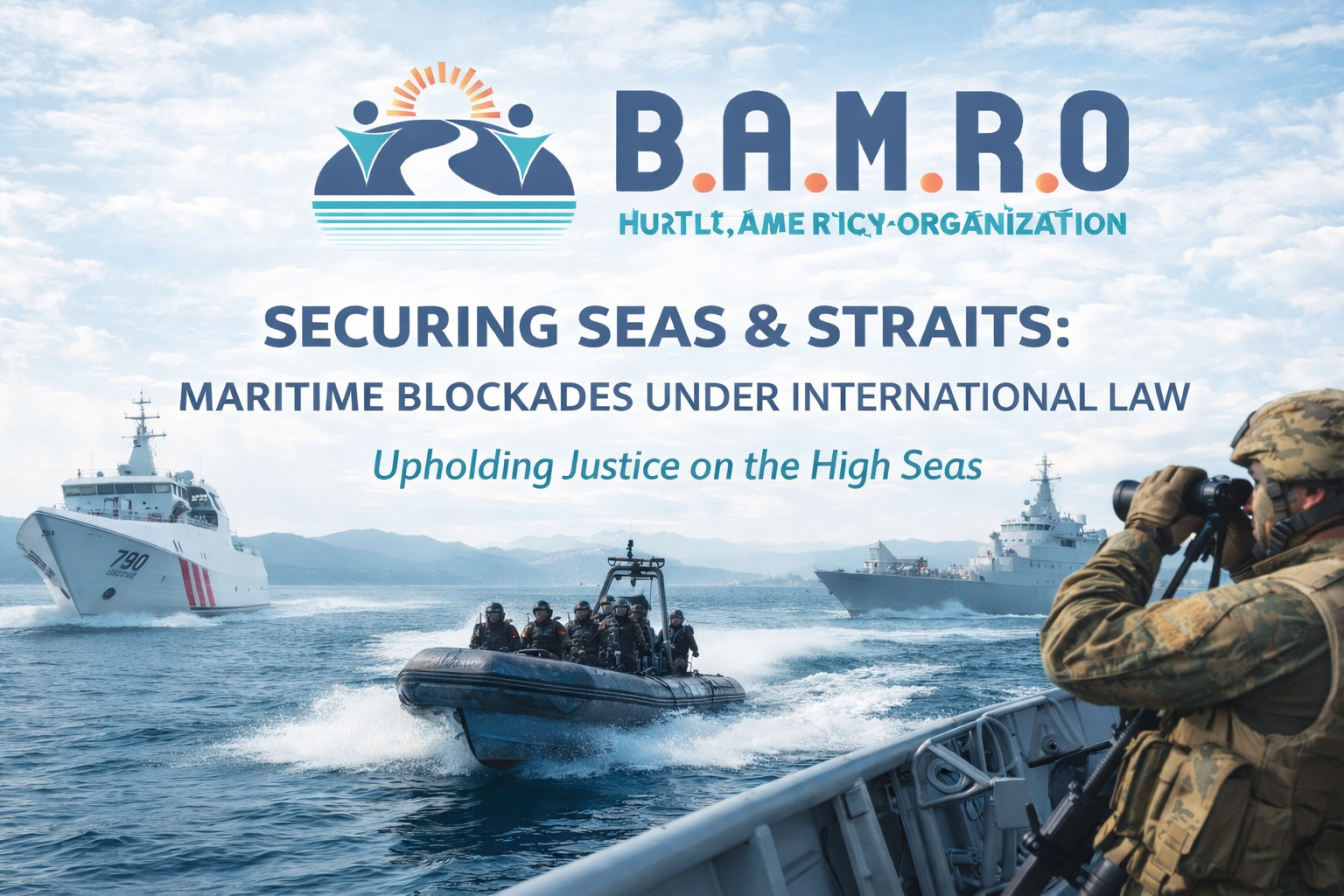
Straits and Seas in International Law: A Legal Study in Light of Their Relationship with Human Rights
Straits and Seas in International Law: A Legal Study in Light of Their Relationship with Human Rights
Abstract
This study examines the international legal framework governing seas and straits, analyzing the relationship between the law of the sea and human rights law. It is based on United Nations Convention on the Law of the Sea as the primary legal reference, alongside international human rights law, to assess the impact of maritime navigation and conflicts on fundamental human rights.
Introduction
International straits and seas represent vital geopolitical components of the global system, serving as essential routes for trade, energy, and communication. However, their importance has extended beyond economic and strategic dimensions to include growing human rights implications.
Legal Framework
UNCLOS regulates straits through key provisions:
- Article 37: Scope of transit passage
- Article 38: Right of transit passage
- Article 39: Duties of ships
- Article 44: Obligation not to hamper transit
Additionally:
- Article 17: Innocent passage
- Article 87: Freedom of navigation
Human Rights Dimension
The application of maritime law intersects with:
- International Covenant on Civil and Political Rights
- International Covenant on Economic, Social and Cultural Rights
Including:
- Right to life (Article 6 ICCPR)
- Right to food (Article 11 ICESCR)
- Right to health (Article 12 ICESCR)
Strategic Impact of Straits
Key straits such as Strait of Hormuz and Bab el-Mandeb are critical to global supply chains.
Contemporary Challenges
- Militarization
- Piracy (Article 100 UNCLOS)
- Political pressure
Non-Traditional Human Dimension
Article 98 of UNCLOS imposes a duty to rescue persons at sea.
This connects to Refugee Convention and the principle of non-refoulement.
This represents a functional legal link between maritime law and human rights law.
Conclusion
Straits and seas are no longer purely geographic spaces but are integral to the protection of human rights.
Prepared by:
Dr. Abdul Samad Mukhlif
PhD in International Law
Advisor to the UN Human Rights Council
President of Belgian Organization for Human Rights and Development
Listings
- 1
- 2
- 3
- 4
- 5