

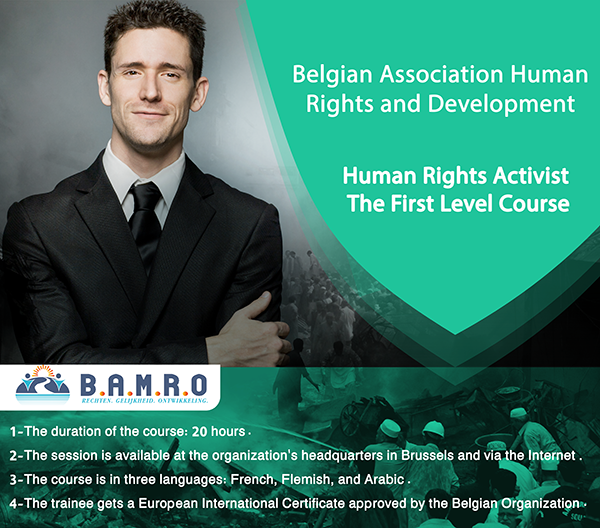
Courses
23-05-2023
Vote
-
For further training via the Zoom program or at our office? ?
Register a
Violation
We you
Contact youS.O.S.
0032 02 7322568
Back to School 2026: 273 Million Children and Young People Worldwide Are Out of School
HUMAN RIGHTS REPORT
Back to School 2026: 273 Million Children and Young People Worldwide Are Out of School
September 2026
Introduction
As the 2026–2027 school year begins, millions of children and students around the world are returning to their schools and classrooms, carrying new hopes for learning and building their future.
Yet behind this scene lies a troubling human rights reality that must not be overlooked.
According to UNESCO's latest 2026 estimates, approximately 273 million children, adolescents and young people worldwide are out of school, representing roughly one in six people of school age.
Of these, approximately 79 million are of primary school age, 64 million are of lower secondary school age, and 130 million are of upper secondary school age.
These figures demonstrate that returning to school is not a reality available to everyone. While millions of children enter their classrooms, millions of others remain outside the education system because of poverty, armed conflict, displacement, refugee situations, discrimination, damage to educational institutions and other barriers.
1. Education Is a Fundamental Human Right
Education is not a privilege or an optional service. It is a fundamental right guaranteed under international human rights law.
Article 26 of the 1948 Universal Declaration of Human Rights recognizes everyone's right to education.
Article 13 of the International Covenant on Economic, Social and Cultural Rights also recognizes the right to education, while Articles 28 and 29 of the Convention on the Rights of the Child affirm children's right to education and the importance of encouraging regular school attendance and reducing dropout rates.
The right to education does not merely mean the existence of a school building. Education must be available and accessible without discrimination, of adequate quality, and provided in a safe environment that respects the dignity of every child.
2. 273 Million Out of School
UNESCO's 2026 data reveal the continuing scale of the global education crisis.
Approximately 273 million children, adolescents and young people of school age are out of school worldwide.
They include approximately:
-
79 million of primary school age.
-
64 million of lower secondary school age.
-
130 million of upper secondary school age.
The data also demonstrate that educational exclusion is not distributed equally around the world. It is closely associated with poverty, levels of development, armed conflict and humanitarian crises.
The figure of 273 million therefore represents more than an educational statistic. It reflects a global human rights challenge connected to development, poverty reduction and equality.
3. Why Are Children Deprived of Education?
Millions of children and young people are excluded from education for various reasons, including armed conflict and war, forced displacement and refugee situations, poverty and families' inability to meet education-related costs, destruction of schools and educational infrastructure, child labour, early marriage, discrimination, lack of appropriate education for children with disabilities, and the distance between schools and rural or remote communities.
In many cases, several of these factors interact, making a child's return to school even more difficult.
4. Armed Conflict and the Right to Education
Armed conflicts are among the most serious threats to the right to education.
Wars do not merely interrupt education temporarily. They can destroy schools, displace students and teachers, disrupt examinations, cause the loss of books and educational materials, turn educational institutions into shelters, and make travelling to school unsafe.
Refugee and internally displaced children face additional challenges involving official documentation, language barriers, differences in curricula, shortages of school places and the difficult economic circumstances facing their families.
Depriving a child of education for several years during a conflict can have consequences that continue long after the conflict itself has ended.
5. Gaza: An Unprecedented Education Crisis
The educational situation in the Gaza Strip is one of the most significant contemporary examples of the impact of armed conflict on the right to education.
Extensive damage to educational institutions, combined with displacement and severe humanitarian and security conditions, has deprived large numbers of children of formal education.
The loss of years of schooling is not merely an educational problem. It threatens children's long-term future and can increase the risks of poverty, child labour, exploitation, marginalisation and serious psychological and social consequences.
Restoring education and protecting educational institutions must therefore form an essential part of humanitarian response and reconstruction efforts.
6. Poverty: When School Becomes a Burden on Families
Even in countries and regions unaffected by armed conflict, poverty remains one of the greatest barriers to education.
Basic education may officially be free, but families often bear the costs of transport, clothing, books, stationery, meals, digital devices and other expenses.
Families living in extreme poverty may be forced to remove their children from school and send them to work to contribute to household income.
Reducing school dropout therefore also requires effective social protection policies and support for the most vulnerable families.
7. Children Most at Risk of Educational Exclusion
Certain groups face a particularly high risk of losing access to education, including refugee and internally displaced children, children living in armed conflict zones, children from poor families, children with disabilities, children in rural and remote communities, stateless children, children affected by disasters and humanitarian crises, and working children.
Girls may also face additional barriers in some societies due to discrimination, early marriage, or economic and social circumstances.
Education policies must therefore specifically address the needs of the most vulnerable groups rather than relying solely on general enrolment indicators.
8. Schools Provide Protection, Not Only Education
Returning to school has benefits that go far beyond acquiring knowledge.
Schools provide children with stability, safety, social protection and psychological support. They can help identify cases of violence and exploitation and reduce the risks of child labour, early marriage, recruitment, exploitation and human trafficking.
Education during conflicts and disasters should therefore not be regarded as something that can simply be postponed until a crisis has ended.
Education is an essential component of humanitarian response and child protection.
9. The Responsibility of Governments and the International Community
On the occasion of the beginning of the 2026–2027 school year, we call upon governments, international institutions, donors, humanitarian organisations and human rights organisations to:
-
Guarantee access to education for all children without discrimination.
-
Prioritise refugee, displaced and conflict-affected children.
-
Protect schools, teachers and students during armed conflicts.
-
Rebuild and rehabilitate schools damaged by wars and disasters.
-
Support poor families to reduce school dropout and child labour.
-
Guarantee inclusive education for children with disabilities.
-
Expand education programmes in emergencies and displacement settings.
-
Provide psychological and social support to children affected by conflict.
-
Strengthen digital education while ensuring that the digital divide does not become a new form of discrimination.
-
Strengthen accountability for violations targeting educational institutions or arbitrarily depriving children of their right to education.
Conclusion
As the new school year begins, millions of children will take their seats in classrooms, while 273 million children, adolescents and young people worldwide will remain out of school.
This figure is not merely a statistic.
It represents millions of children and young people whose opportunities for employment, development and participation in society may be affected, and millions of families facing poverty, displacement, war, discrimination and other circumstances that prevent access to education.
Guaranteeing the right to education is not the responsibility of educational institutions alone. It is a shared responsibility of governments, the international community, humanitarian and human rights organisations, and civil society.
During the back-to-school season, the question should not only be: How many children have returned to school? We must also ask: What will we do for the 273 million who remain outside it?
Investing in education means investing in people, and protecting schools means protecting the future of society.
Listings
- 1
- 2
- 3
- 4
- 5